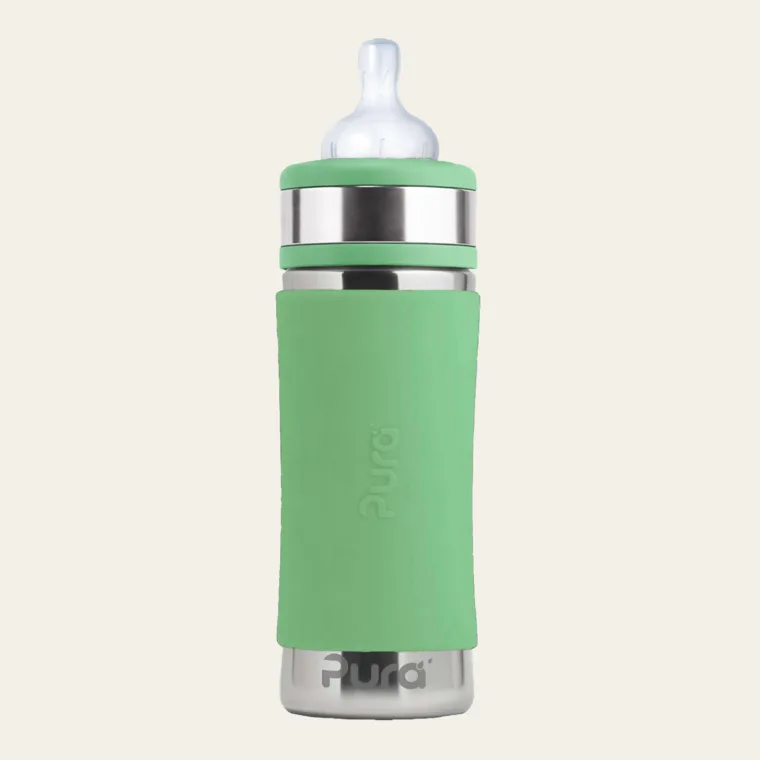
Pura Stainless Kiki 9 oz Baby Bottle

Pura Stainless · Bottle

Current best-in-class pick

Kiki 9 oz Baby Bottle

A stainless-steel, plastic-free bottle with a medical-grade silicone nipple and modular conversion parts.

  • baby
  • bottle
  • plastic-free
  • MADE SAFE

Why it earns a place

Its material design avoids plastic food contact, the exact bottle appears in MADE SAFE's certified product directory, and the maker explicitly excludes phthalates and lead.

Phthalate assuranceCertified + explicit claim

What backs the claim

MADE SAFE lists the Kiki infant bottle, while Pura identifies the current vessel as stainless steel with medical-grade silicone and no plastic, phthalates, BPA, BPS, polypropylene, or lead.

What it does not prove

Public rating volume is thinner than our other picks, and we found no current batch-level laboratory report on the public product page.

MADE SAFE certified · plastic-free design Check the evidence → Reviewed 2026-09-08

Where to buy

Lowest item price first

Checked September 8, 2026

These are direct store links; no affiliate commission is currently attached. How our links work.

Prices, stock, size, scents, subscriptions, shipping, tax, and formulas can change. We sort the displayed item price, not delivered cost. Verify the exact variant and ingredient label at checkout.

Why the category matters

Research behind the recommendation.

View all research →
Pregnancy Human cohort

A large null study is evidence, not a universal guarantee

No primary association remained statistically significant after false-discovery-rate correction, and the repeated-outcome and mixture analyses also showed no significant overall association after correction. Selected MMP findings appeared in secondary age-two definitions but were not consistent across ages or analytic approaches.

Environment International, 2026 Read summary
Policy & measurement Human cohort

When exposure and response are both measured in urine

Most associations between early-pregnancy urinary phthalate or replacement metabolites and urinary placental-angiogenesis or kidney-related proteins were imprecise. The highlighted MCPP–NGAL association was no longer statistically significant after multiple-comparison correction.

Reproductive Toxicology, 2026 Read summary